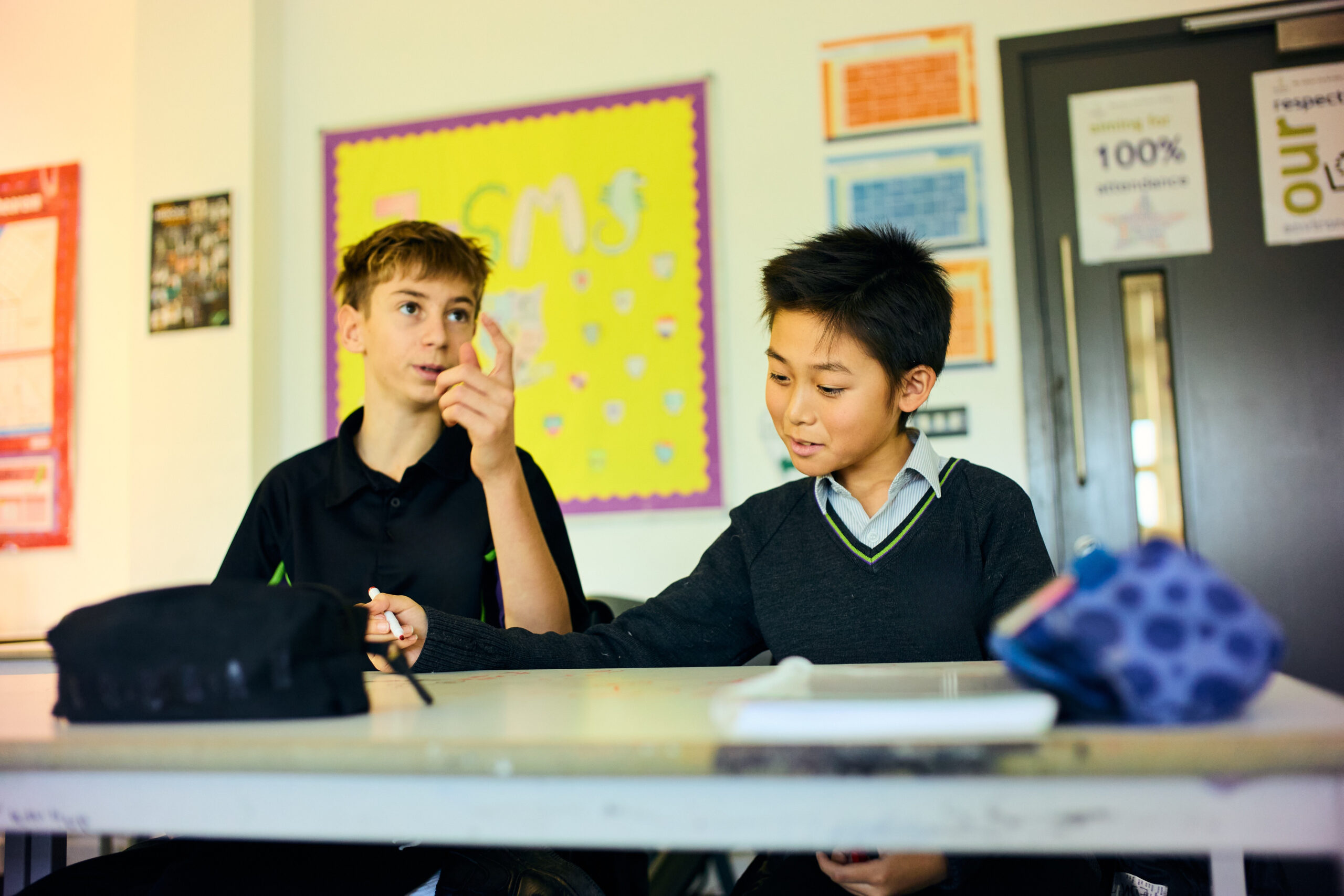
In maths, we know having the correct answer doesn’t always equal secure understanding. If we want to find out what pupils really know, we need to look beyond what’s written down.
“But I know the answer!”
We tend to judge mathematical success by what’s on the page. If the method is correct, and the answer matches the mark scheme, complete knowledge is assumed. But this can be misleading.
Consider a pupil who correctly adds 2/3 + 1/12, rewriting 2/3 as 8/12 to get 9/12. They can follow clearly follow the algorithm, but do they really know what they’re doing? We can’t tell this by looking at their answer alone, we have to talk to them. If we ask why, they might reply “that’s the method” without being able to articulate what each step was achieving and why. They might not be able to explain that they changed one fraction to match the other’s denominator, so the numerators could be added. And if they can’t explain this, their knowledge is insecure.
This kind of purely procedural knowledge is fragile. It performs well in familiar contexts but disintegrates when pupils face something unfamiliar.
What oracy reveals
Secure mathematical understanding becomes visible when pupils have to articulate their choices, convince others and justify their reasoning. Oracy matters in maths because it’s a window into the mathematical mind, exposing what written answers often hide.
A pupil may correctly calculate the area of a trapezium but explain the formula as “you times the parallel sides and divide by two and times by the height because that’s the rule”. Spoken aloud, this sounds plausible. Examined closely, it reveals a conceptual gap, the pupil has not grasped that the formula represents the average of two rectangles. Talk can expose whether conceptual understanding is missing.
The currency of maths
The currency of maths is proof: convincing others that a solution is correct. There are many ways this can be done in a classroom without needing to spend lots of time on writing formal proofs. Exploratory talk, where pupils listen to each other’s ideas, question them, and build on them through debate, is a great place to start.
This culture of debate and justification doesn’t appear spontaneously, but it can be grown through intentional classroom practice. Teachers can model the art of good mathematical explanations by using sentence starters and precise mathematical vocabulary. They can select problems with multiple correct answers or multiple solutions. They can scaffold discussion to reduce the barrier to entry so all pupils to take part.
Key questions
In Teaching Children How to Use Language to Solve Maths Problems, Mercer and Sams show that when pupils discuss their mathematical thinking, their understanding deepens and they become better problem-solvers. This came from teachers asking simple questions like:
- “Can you explain why you chose that method?”
- “How did you reach that conclusion?”
- “Can you convince me?”
For teachers, talk transforms invisible thinking into something observable and teachable. It reveals where understanding is secure and where misconceptions emerge beneath correct answers.
A word on the national picture
There’s a growing national focus on oracy in schools. Maths teachers shouldn’t be passengers in this process, stuck with a framework built for other subjects and retrofitted onto maths. Instead, we should think deeply about the role of pupil talk in our classrooms and set out how we believe a national framework should apply to, and improve, mathematics.
Great mathematicians are clear communicators who explore ideas through conversation and collaboration. This will be even more true in an age of advanced AI, where we need people who can not just “do” the maths but also explain it. When the right conditions are in place, oracy becomes a powerful way to make mathematical understanding visible.