
Like all maths teachers, we’ve wondered about why more girls don’t choose to study maths. So we looked at the data and found that much of our prior understanding was wrong. There’s not an issue with teenage girls choosing maths at A-level. The issue comes much earlier.
The GCSE Bump
Girls and boys are about as likely as each other to get a Grade 7 or above at GCSE (20% vs 21%). But boys are 50% more likely than girls to complete a maths A-level (15% vs 10%). It feels logical to say that, given girls are doing just as well as boys at GCSE, we just need to persuade those girls to take maths A-level. This leads to work focused at 15-16 year olds in the A-level choices window. This work is valuable, but it may miss a bigger opportunity for impact.
When you look at maths excellence through the system, as the University of Nottingham do, we see that GCSE is an outlier.
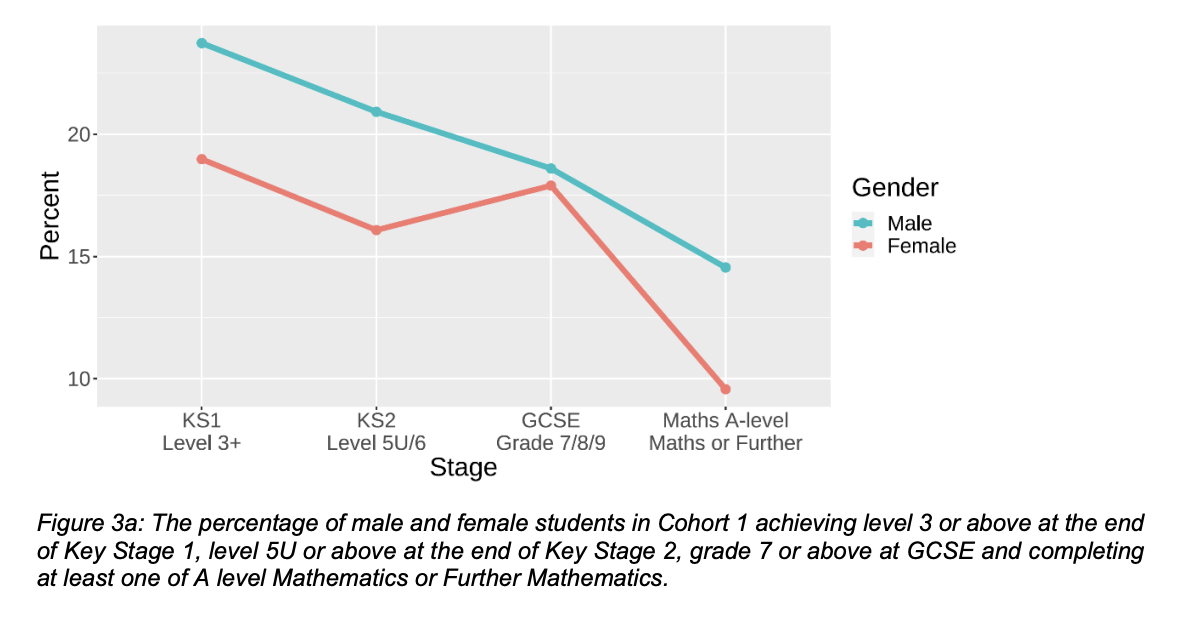
There is a ~5 percentage point gap between boys’ and girls’ likelihoods of high attainment in maths at every stage of school – except GCSE. From KS1, boys are more likely to do well in maths. The gap that is open at age 7 persists through to age 18, and it doesn’t change in size except at GCSE.
We hypothesise that something is happening at GCSE that is masking a deep and persistent gap and that a successful strategy for narrowing the gap at A-level has to recognise this. Whilst we cannot know exactly what’s going on at GCSE, we can share the data. For example, a third of girls achieving a Grade 7 or above at GCSE were not on the ‘excellence pathway’ at KS1 or KS2, as defined by Nottingham’s research. These were disproportionately girls from the richest income quintile.
We can make all sorts of hypotheses about why this is. Perhaps a large cohort of girls push to excel in their maths GCSE despite negative prior experiences of the subject, yet have no intention of studying it in the future? We don’t know. But if we want to close the gap, we need to look at the trend as a whole, not the outlier.
Believe in our girls, and believe in them early
Children form ideas of who they are and what they’re good at early, well before they’re even seven. They do this from looking at the signals given by adults around them, and this leads them to disproportionately rule out fields like maths. By the time subject choices arrive, girls may have internalised stereotypes that make it seem maths can’t be for them.
Emerging evidence suggests that introducing children to role models working in a range of sectors and integrating career education into the curriculum can unlock wider aspirations. A pilot study conducted by The Careers & Enterprise Company (CEC) showed that introducing career-related learning increased girls’ interest in male-dominated fields by 30%. Over four-fifths (83%) of teachers saw a rise in children’s confidence when exploring these different career possibilities.
As well as older role models, girls need environments where they see other girls enjoying maths. In our maths circles, we’ve found that girls are much more likely to stop attending if they are the only girl in the group1, so try and avoid situations that allow this to be the case. A lack of female peers increases the already prevalent sense that maths is for boys and reduces girls’ enjoyment and achievement.
None of this is an argument for well-meaning but ultimately harmful attempts to make maths more relevant for girls through superficial stereotypes about their interests. Gendered and simplistic maths problems will not persuade girls to continue with maths. Patronising questions about how to calculate the cost of handbags are not the answer. Girls deserve the same access to ambitious and exciting maths as boys.
Every child deserves the opportunity to harness the power of maths. It’s a scandal that by age seven we already see the gap that will persist through to A-level. We need to seize every chance we get to change the environment in which girls form a relationship in maths, from seeing role models to meeting peers. And in the process, we should uphold the same ambitious expectations for girls as we do for boys.
Footnote 1: The same is true of boys, but the situation is much rarer.