This post first appeared in TES magazine here. It is reproduced with their permission.
New research from UCL shows only 9% of disadvantaged pupils with strong maths scores at the end of primary school score go on to get at least a B in maths A-Level. That’s like losing a packed football stadium’s worth of talent every year. We’re watching potential drain away and facing a devastating drought of future mathematicians.
This isn’t a collapse in the exam years. If we want to understand why this maths pipeline leaks, we need to look at the experience of moving to secondary school. For too many disadvantaged pupils, this marks a decline in engagement and enjoyment from which they never recover.
The Leaky Pipeline
An alarming number of children with huge potential in mathematics fall off track before they reach the age of 16. Around 31,000 disadvantaged pupils achieve a KS2 maths score in the top 25% nationally. But by GCSE, around half are no longer getting top grades. By A Level it is even worse. Only 9% of those 31,000 children go on to get at least a B grade in mathematics.
The talent pipeline doesn’t leak – it drains. And this matters. It is closing down opportunities for these children, who lose out on the career options and earnings premium that maths brings. And it’s closing down opportunities for us as a nation. Our economy remains hamstrung by skills shortages; our society never benefits from the inventions these pupils were on track to create.
And whilst problems exist across the board, not all pupils are equally likely to fall off track. High-achieving white boys from disadvantaged backgrounds are 16 percentage points less likely to take maths A-Level than their black and asian peers. Meanwhile, disadvantaged white girls who take A-Level maths are 7 percentage points less likely than their male peers to achieve a B or above.
The early cracks
The UCL research shows where pupils fall away. Our own research at Axiom Maths shows why. Disengagement arrives early in secondary school. We surveyed pupils who scored above 110 in their SATs, split by socio-economic background. Disadvantaged pupils’ (SES grades C2DE) attitudes towards learning and maths diverge significantly from their advantaged peers (SES grades ABC1).
At the end of primary school, high-attaining disadvantaged pupils are more likely to say that their maths lessons are fun than advantaged pupils. But by the end of Year 7 this has reversed. The proportion of disadvantaged pupils who think their maths lessons are fun has halved, and advantaged pupils are now twice as likely to think this.
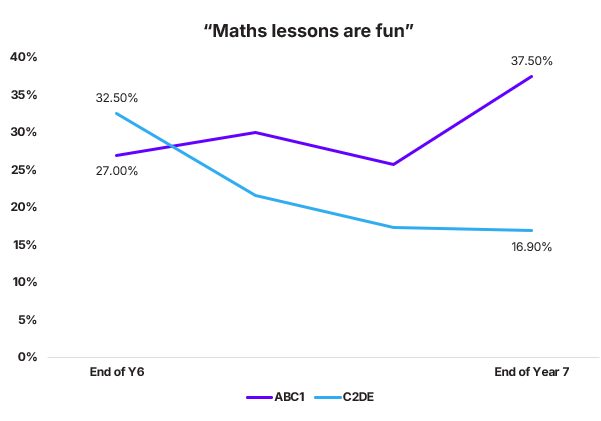
How can it be that we open such a tremendous gap in enjoyment, where previously there was none, all in the space of a year? We are systematically boring our most disadvantaged children, whilst exciting the more advantaged. This disadvantage gap in experience is bad in and of itself, but worse when we see the gap in attainment it later leads to.
This fall in enjoyment happens in the context of a worsening classroom environment. Less advantaged pupils are much more likely to say their classmates are “messing around”, “talking when they shouldn’t be” or “not completing classwork”. Their learning environments feel noisier and less focused. Meanwhile, their advantaged peers experience calm and productive classrooms.
A path forward
We need the young mathematicians entering our secondary schools to enjoy their experience of maths more. Too often we try to do this by acting as if maths itself were the problem – it needs to be disguised in a game or a colouring sheet, presented through a problem about footballs or handbags.
We believe that maths itself is the answer. The drop-off in enjoyment comes as secondary schools try to address a myriad of different gaps, as each pupil arrives with a different set of prior knowledge. They do their best to make it ‘engaging’, but they’re disguising what for many pupils is a year or two of revising KS2. There is an opportunity coming to revise the primary curriculum so that every pupil masters a common set of fundamentals. This creates an opportunity to strive for a much richer experience of KS3 maths, where every pupil gets to grapple with and solve meaningful problems.
It cannot be right that we lose 91% of children from disadvantaged backgrounds who were on track to excel in mathematics. Their futures, and ours, depend on changing this.
Post written by David Thomas.